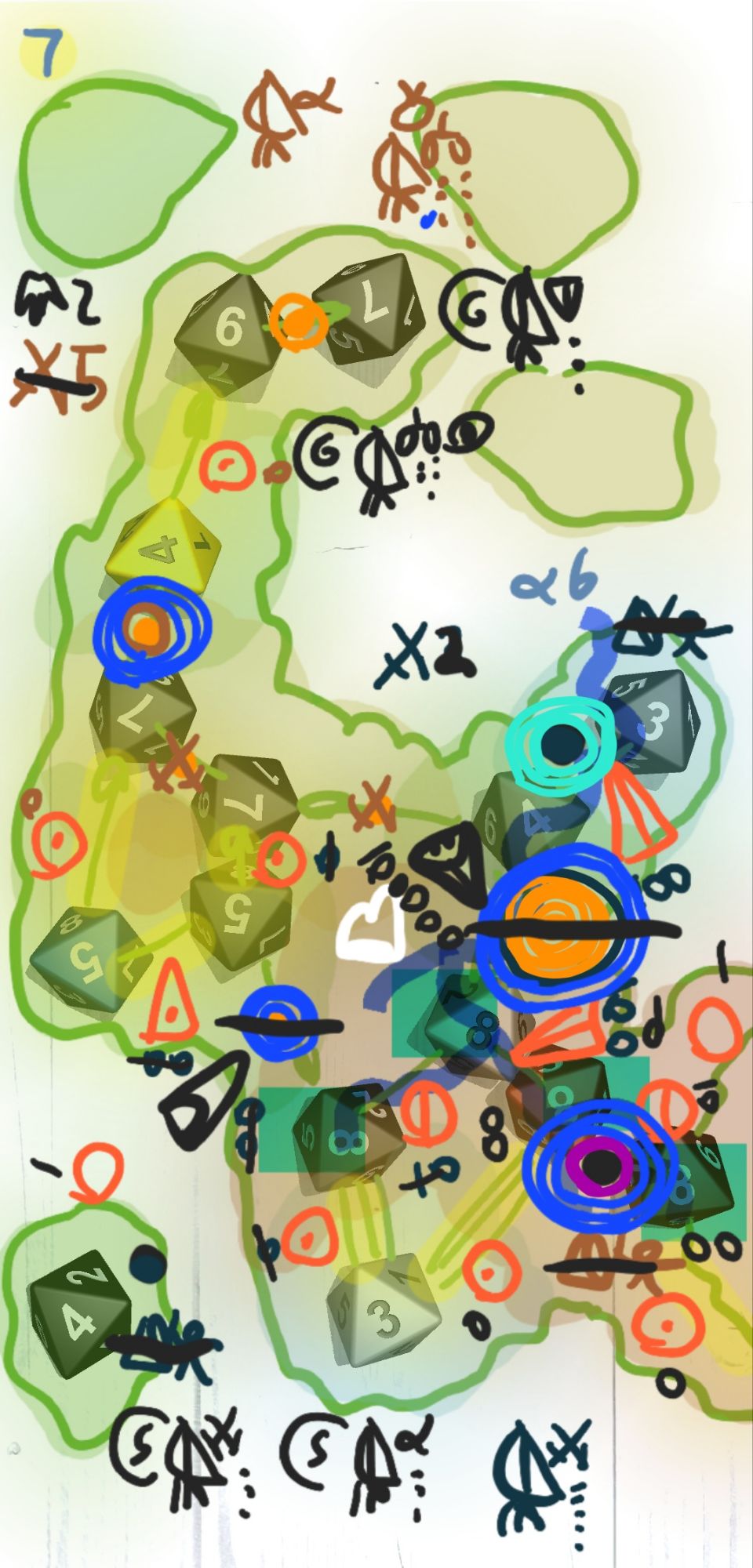
The mountainous topography of the region conspires with subtropical heat to create a great stretch of arid land at the “back” of what residents refer to as “the Claw.” Rains fall liberally from the end of winter months well into the summer, promoting an uncomfortably humid monsoon season on the windward “front” of the Claw. In contrast to this harsh environment, the seas make excellent fishing, complemented by the great arterial river of the “Inner Claw” region, also rich in fish.
There are two elder cultures here, the Silver of the Inner Claw, and the Gold of the Outer Claw. Both sustain themselves largely on trades of the sea. The growing power of Red can also be felt at the Joint of the peninsula.
A generation ago the grand capital of Silver was considered a marvel, wondrous in extent, marshalling wealth from its many mines and outposts through ages of trade secrets. Today the gilded halls of the city now adorn the length of the great riverbed over which they once towered. Further down the river, at the tip of the Inner Claw, the descendants of Silver have rebuilt, sustaining echoes of their former grandeur through fishing and piracy.
The Outer Claw of the peninsula is the ancient home of the Gold people. Once widely distributed along the Inner Sea of the Claw, the conflicts that ensued with the collapse of Silver’s capital reverberated into Gold territory—there now exists a buffer of bandit fiefdoms between the two cultures. In the meantime, Gold grew to consolidate its people and the wealth of its trading enterprises around the precinct of their holiest site, where offerings of foreign fruits are made at the beginning of every summer.
High in the mountains to the south, where the peninsula joins the mainland, a former Gold colony has recently asserted its full independence—they are now the Red. Capitalizing on overland trade and resources abandoned during the collapse of Silver’s homeland, Red have grown into a city on the level of the other peoples of the region.
 Five and One Fifth Lights
Leave a comment